Air Conditioning Repair in Hudson, NC
Keep it cool with Hickory – call us today at
(828) 679-1067!
Hudson has grown into one of Caldwell County's more active residential communities, with a housing landscape that stretches from established neighborhoods along the Catawba River corridor to newer subdivisions that have developed along NC-321 as families have moved into the area over the past couple of decades. That range of home ages and construction styles means the cooling systems our technicians encounter in Hudson vary widely, from older central air setups in homes that have been in the same family for years to modern heat pump systems in recently finished builds. We are prepared for all of it and bring the same standard of care to every call regardless of what we find when we arrive.
Our AC repair services in Hudson cover the full range of what residential cooling systems need, including:
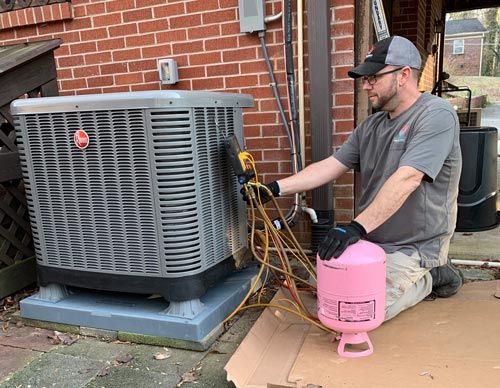
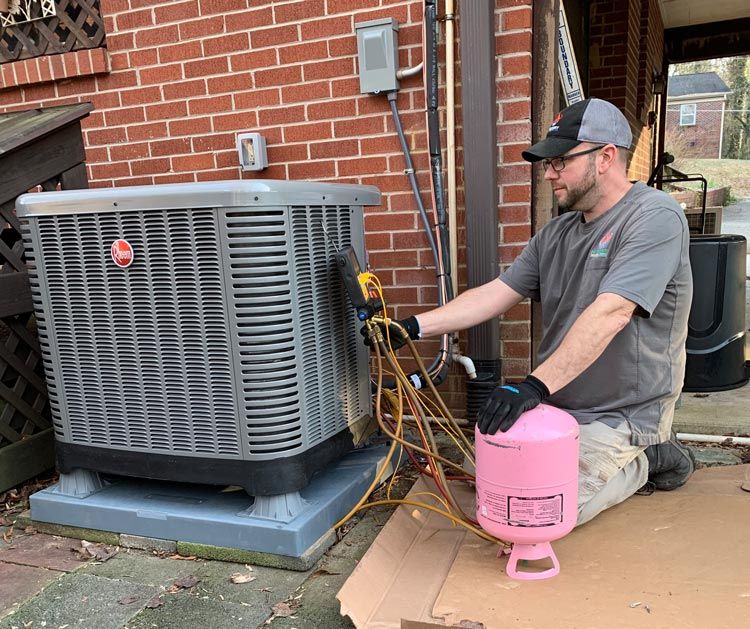
- Locating refrigerant leaks at coil joints, flare fittings, and line set connections, sealing the breach, and restoring the system to its proper operating charge.
- Repairing or replacing compressors, run capacitors, dual-run capacitors, contactors, and condenser fan motors that have worn out under the demands of Caldwell County summers.
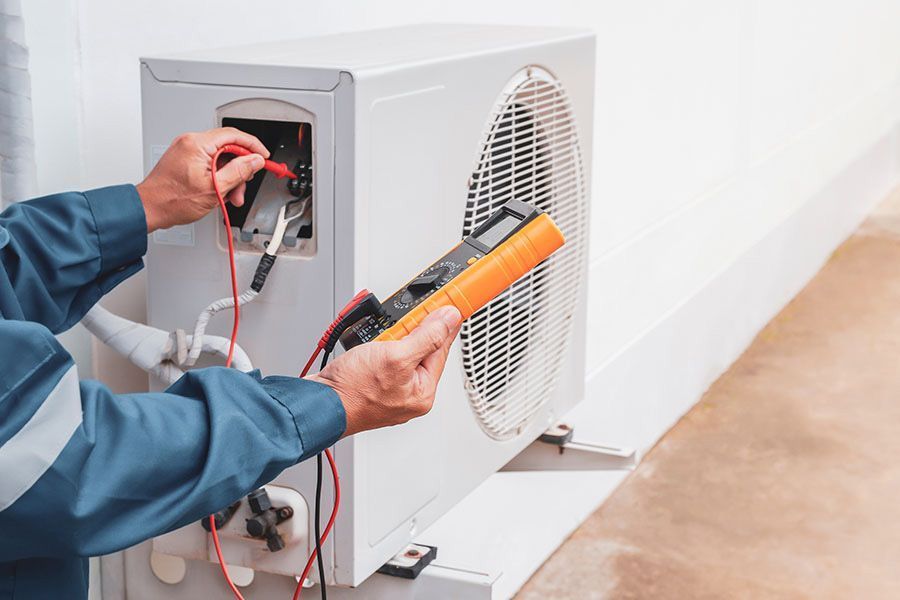
- Tracing and resolving electrical faults including corroded wiring, failed fuses, damaged disconnect enclosures, and control board communication errors.
- Deep cleaning evaporator and condenser coils coated with the seasonal pollen, organic debris, and humidity-driven buildup that accumulates on outdoor units in this part of the foothills.
- Flushing and treating condensate drain lines and drain pans that back up from algae and mildew growth during Hudson's warm, moisture-heavy summer months.
- Diagnosing and replacing thermostats, sensors, and control modules that are causing inconsistent temperatures, missed cooling cycles, or abnormal system behavior.
We finish every service call with a plain-language summary of what we found and what we did, because we think homeowners deserve to understand the condition of their own equipment.
CALL NOW!
Your AC May Be Telling You It Needs Help
Hudson sits along the Catawba River in a stretch of Caldwell County where summer arrives with both heat and humidity that can linger well into September. The river corridor keeps moisture levels elevated through the heart of the cooling season, and systems that are already carrying any kind of underlying problem tend to reveal themselves under that sustained load. The challenge is that some of the most telling signs of a struggling AC are easy to dismiss as normal summer behavior until the system stops working altogether.
Here are the signals worth paying attention to before your AC reaches a breaking point:
- Your home never quite settles at the temperature your thermostat is set to, hovering a few degrees warmer no matter how long the system has been running.
- The outdoor unit runs for unusually long stretches or seems to never fully shut down, which points to a system working well beyond its normal capacity just to maintain a baseline.
- You notice water pooling around the base of the indoor air handler or moisture staining on the ceiling or wall nearby, typically a sign of a condensate backup or a drain pan that is overflowing.
- There is an unfamiliar sound coming from the outdoor unit during operation, whether that is a persistent rattling, a metallic scraping, or a low hum that cuts in and out irregularly.
- Rooms that used to cool evenly now feel noticeably different from one another, pointing to possible duct leakage, airflow imbalances, or a system that is losing capacity unevenly.
- Your electricity bill has increased from the same period in prior years in a way that does not match any change in how you are using your home.
Any one of these on its own warrants a closer look. More than one occurring together is a strong signal to get a technician out before the situation escalates into a full system failure.
What Hudson's Environment Does to Cooling Equipment
The Catawba River runs right through Hudson's back yard, and that proximity shapes the local climate in ways that matter directly to how long residential AC equipment lasts and how often it needs attention. River-adjacent communities like Hudson tend to experience higher baseline humidity than surrounding areas, and that extra moisture affects nearly every component of a cooling system in one way or another. Layered on top of that is the dense canopy of mixed hardwoods that lines much of the riverway, contributing to one of the heavier pollen and organic debris loads in the region.
- Evaporator coil icing is a more frequent occurrence in Hudson than in drier communities, because systems operating in high-humidity environments are more susceptible to airflow restrictions that push coil temperatures below freezing, particularly when refrigerant levels are even slightly low.
- Condensate system failures happen with regularity in Hudson homes during the summer, as the volume of moisture the system pulls from the air is simply higher here than in less humid areas, filling drain pans faster and overwhelming partially blocked drain lines more quickly.
- Electrical component corrosion, particularly on contactors, terminal blocks, and control boards, is a documented consequence of sustained moisture exposure in river corridor communities, where metal components inside outdoor enclosures face conditions closer to coastal environments than inland ones.
- Refrigerant line set degradation develops faster in homes near the river where the combination of ground moisture, organic acids from decomposing leaf matter, and seasonal temperature swings accelerates the breakdown of insulation around copper lines and weakens brazed connections over time.
- Blower motor and air handler wear accumulates faster in homes where the system runs long daily cycles to manage both temperature and humidity load simultaneously, a combination that is essentially the default operating condition for Hudson AC systems through July and August.
These are not edge cases or unusual failures. They are the natural outcome of Hudson's specific geography acting on residential equipment across seasons, and they shape the way we approach every diagnosis and repair in this community.
Figuring Out a Stubborn Problem in the Rivermont Area
Midway through last August, we got a service call from a homeowner named Sylvia who lived in a single-story home in Hudson's Rivermont area, not far from the Catawba River. She had been dealing with a cooling problem for nearly two weeks, during which the system ran almost constantly but kept the house no lower than 81 degrees. She had already called another company who told her the system was simply too old to work properly, but she wanted a second opinion before committing to a replacement.
When our technician arrived and did a full inspection, the picture was more nuanced than the previous diagnosis suggested. The condenser coils were heavily fouled with a mix of cottonwood, pollen, and fine organic matter that had compacted against the coil fins over what appeared to be several seasons without cleaning. The refrigerant charge was also low, the result of a slow leak at a brazed joint on the suction line that had gone undetected. Together, those two problems had been compounding each other: the restricted coil made the refrigerant deficit worse by preventing proper heat exchange, and the low charge made the system work harder against an already compromised coil.
We cleaned the coils, repaired the leak, and recharged the system. The unit's age was real, but the equipment itself was mechanically sound once it could actually operate under proper conditions. Sylvia's home was cooling normally within two hours of us finishing the repair. She told us she had been bracing for a replacement bill and was genuinely relieved to hear the system had years of service left in it if maintained properly going forward. That kind of honest outcome is exactly what we aim to deliver.
What Keeps Hudson Homeowners Coming Back to Us
Hudson is a community that has grown steadily because people genuinely want to live here, and the homeowners we work with expect their service providers to show the same kind of investment in the area that they have made themselves. We meet that expectation by doing the work right, being straight with people about what we find, and standing behind every repair we make. That is not a complicated formula, but it is one that requires consistency to build trust over time, and that is what we have worked to do.
Here is what that commitment looks like when you call us:
- We offer reliable, fast, and efficient AC repair services along the Catawba River corridor, delivering professional solutions that restore your comfort and keep your system running smoothly.
- Every estimate we give is an honest one with no inflated line items, and the price we quote before starting is the price on the final invoice.
- We use quality replacement parts rated for the conditions they will operate in, not the lowest-cost option that gets the job done today and fails in six months.
- Our maintenance plans are designed with Caldwell County's climate in mind, focusing on the specific failure points that Hudson's river corridor environment accelerates.
- We protect your home throughout every visit, keeping work areas clean and making sure nothing is left behind when we go.
- We take a personalized approach to every home rather than applying a one-size-fits-all diagnosis, because a riverside ranch built in 1972 and a newer two-story subdivision home have genuinely different service needs.
Our goal on every Hudson service call is to leave the homeowner more informed, more comfortable, and more confident about the equipment running their home than they were when we arrived.

What Hudson Homeowners Ask Us Most
Hudson's Catawba River setting creates specific conditions that homeowners here encounter year after year. These questions come directly from the conversations we have most often on Hudson service calls.
- Does river proximity mean I need AC maintenance more often? The elevated humidity near the Catawba River accelerates condensate buildup, promotes corrosion on electrical components, and contributes to faster coil fouling. Consistent annual service is especially important in this corridor.
- My older system worked fine last summer. Why is it struggling now? Age-related wear accumulates gradually and often surfaces suddenly. A capacitor weakening last season may have finally failed, or a slow refrigerant leak may have dropped the charge below the threshold where it shows in performance.
- What causes ice to form on my AC and is it safe to keep running it? Ice indicates restricted airflow, low refrigerant, or both. Running an iced system risks permanent compressor damage. Shut it off, let it thaw completely, and call a technician before restarting.
- How long does a typical repair take? Most standard repairs, including capacitor swaps, refrigerant recharges, coil cleanings, and contactor replacements, take one to three hours. More complex work takes longer, and we will give you a realistic estimate before we begin.
- What can I do between service visits to help my system? Replace the air filter every one to three months and keep the area around the outdoor unit clear of grass and debris. Everything beyond that is best handled by a technician.
Check out the other HVAC Services we provide in Hudson, NC
Click on the services below to see how Hickory Heating & Cooling can keep your home Comfortable.